[A] report from the Vermont Chamber of Commerce says the state needs to add 10,000 people to its workforce every year to grow the economy.
The Vermont Futures Project released a report Monday that says 10,975 more people are leaving the workforce every year than entering it.

The so-called workforce supply gap is the result of more people retiring and fewer people entering the workforce. According to the report, 11,375 Vermonters retire every year, and an additional 7,600 jobs are open for other reasons. At the same time, only 8,000 young people enter the workforce from either high school or college.
To fill the gap, the report suggests that 10,000 people should be added to Vermont’s workforce every year by 2040. To house them, the state would need to add 5,000 new and retrofitted housing units each year starting in 2040, the report says.
Betsy Bishop, the president of the Vermont Chamber of Commerce, said the organization is asking the Legislature to allocate $200,000 to the Agency of Commerce and Community Development to market Vermont to tourists as a good place to live.
The agency was already allocated $200,000 in 2015 in part to promote Vermont as a good place to do business. Bishop said the new money should go to allow the Department of Tourism and Marketing to continue its efforts.
The chamber has already started using its own money to do similar marketing, Bishop said. The chamber is including profiles of people who moved to Vermont after visiting in an annual book it distributes at local chambers of commerce.
“As you increase the workforce population, businesses now have a larger pool of people to hire, and they can now start thinking about expanding areas of their business, and right now they’re stifled from doing that because there’s not enough workers to hire,” Bishop said.
She said efforts to move more Vermonters out of the criminal justice system and into the workforce should continue, and that Vermont should eliminate the so-called benefits cliff that discourages people from entering the workforce for fear of losing subsidized housing and health care. But she said more people still need to come to Vermont.
“Even if we do (all those things), we’re going to have a gap,” Bishop said. “What we’re focused on is, ‘How do we get a few more people here?’”
Bill Shouldice, the CEO of the Vermont Teddy Bear Co., is the chair of the Vermont Futures Project. He said getting people to move to Vermont and to stay here after college would also be key to increasing the workforce.
“Anything short of 10,000 (new people per year) relative to the population curve and the relative growth we have in Vermont will mean less economic opportunity,” Shouldice said.
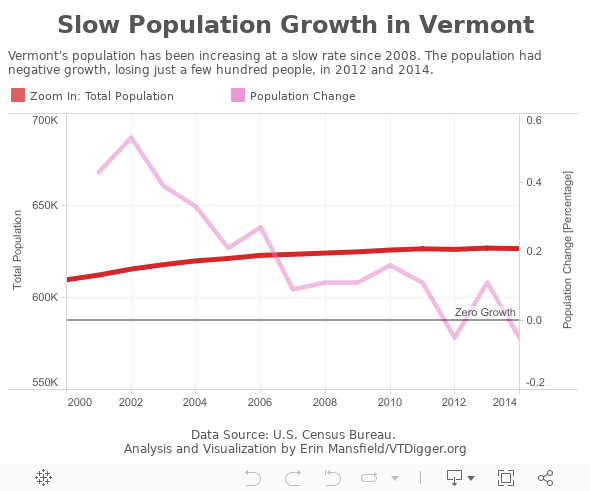
Data from the U.S. Census Bureau show that Vermont’s population increased from about 610,000 in 2000 to 627,000 in 2014. However, the population growth rate during that period was never higher than a fraction of a percent, and the population actually declined marginally in 2012 and 2014.
Economists and demographers say one of the main reasons for low population growth is that Vermonters are not having enough children. Data from the U.S. Centers for Disease Control and Prevention for recent years show that Vermont women have an average of 1.6 babies over a lifetime, compared with 1.9 nationally.
“We have to leverage our recreational assets — and that’s not just skiing,” Shouldice said. He pointed to his hometown near Lake Dunmore, which is southeast of Middlebury and attracts second homeowners.
“There are people who own second homes around that lake who own large corporations and we haven’t even talked to them yet” about living here, investing in an existing business, starting a business or opening a satellite location in Vermont, he said.
To get young professionals to move to or stay in Vermont, Shouldice said the state could also work with people in higher education to increase internship opportunities for students. As an example, he said Ireland requires businesses to take interns because it’s a good way to grow the workforce.
Most of all, Shouldice said Vermont should embrace immigrants and ethnic diversity as a way to increase the workforce. “I know that can be controversial, but I also know that unless we come together … we’re going to be sitting here with not enough folks to get the job done, and that’s not acceptable.”